

These ordinances do not specify a mowing schedule, grass height, or a requirement to mow all detention basin vegetation. It addresses planting, stormwater performance, and long-term maintenance. The detailed maintenance requirements appear in a separate article of the same ordinance. Township of Manheim, PA
On the linked page, Article IV:
SectionRequirement relevant to basin maintenance§ 432-20DA planting plan is required for every vegetated stormwater management facility.§ 432-20D(1)Vegetation must be native or naturalized/noninvasive and suitable for the site’s soil and water conditions, unless the BMP manual specifies otherwise.§ 432-20D(2)–(3)Invasive plants cannot be included in planting schedules. Existing native vegetation being retained must be identified and protected on the plan.§ 432-21DStorage facilities, including normally dry basins, must drain their storage within the specified 24-to-72-hour period after the design storm.§ 432-22E(4)Post-construction stormwater facilities require assured long-term operation and maintenance.
These provisions support appropriately designed vegetated basins. They do not establish a universal lawn-style mowing requirement. Township of Manheim, PA
The specific maintenance rules are in Article VI, Operation and Maintenance of Facilities:
SectionWhat it requires§ 432-26AA township-approved operation and maintenance plan, recorded with the required agreement and easement.§ 432-26C(1)(a)[1]Inspections annually for the first five years, every three years thereafter, after qualifying major storms, and as the maintenance plan specifies.§ 432-26C(1)(a)[2]Keep pipes, swales, and detention facilities unobstructed and in their original design condition.§ 432-26C(1)(a)[3]Remove accumulated sediment so it does not reduce storage or conveyance capacity.§ 432-26C(1)(a)[4]Reestablish vegetation in eroded or unsuccessfully planted areas. Seed mixtures require township approval.§ 432-29A(1)Private owners must maintain facilities according to the approved maintenance plan.§ 432-30BObtain necessary approvals before landscaping or altering facilities. Vegetation must not adversely affect basin or easement function.
For a particular basin, its approved planting plan and operation and maintenance plan are the documents to check for mowing instructions, alongside these ordinance requirements. Township of Manheim, PA
The wording “mow as appropriate for vegetative cover species” does not appear on the page you linked, so it should not be quoted as a provision of that page. Township of Manheim, PA
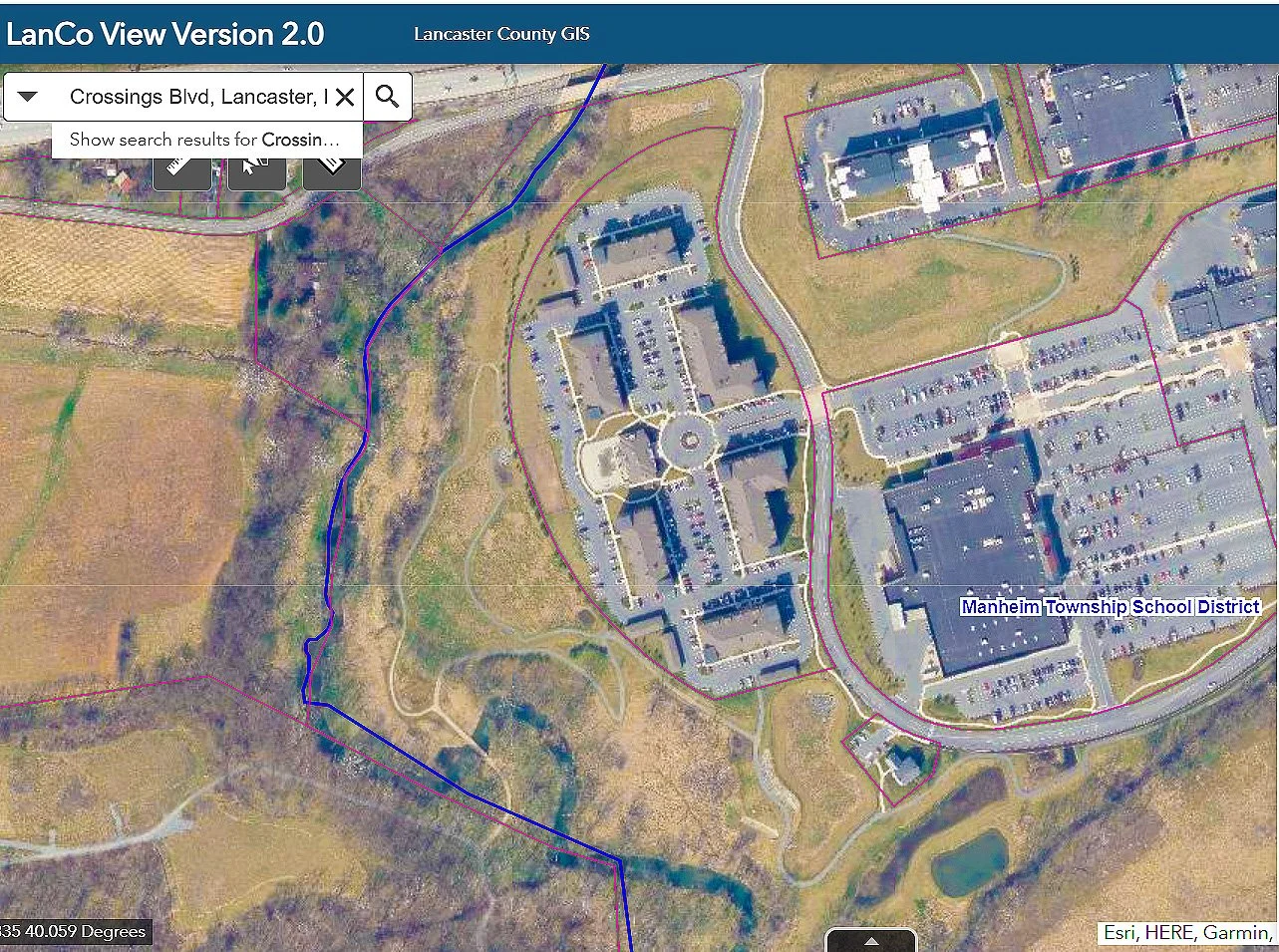
Above: This image shows the Manheim Township boundaries (blue line) and the property boundaries of High Real Estate (red line). So the paths and detention basins are owned by Manheim Township and maintained by High.
Meadow Mowing Recommendations
From Penn State, Xerces Society, etc.
If wildlife and pollinators are the primary concern, I would leave the meadow standing now. Early October is a poor time to mow while your goldenrod and boneset are still flowering. Mowing would remove food that insects are actively using. Goldenrod is especially valuable for late-season pollinators, including migrating monarchs, and boneset supports bees, butterflies, and other flower visitors. extension.psu.edu
For your large meadow in southeastern Pennsylvania, I recommend this approach:
Leave it standing through autumn and winter. Its value continues after flowering. Standing stems, grasses, and plant litter provide overwintering habitat for insects. Cutting everything after the first frost still removes that habitat. Xerces Society
Plan necessary mowing for late winter or very early spring, before substantial new growth and bird nesting. In your area, roughly late February through March is a practical planning window, adjusted to that year’s conditions. Penn State recommends late-winter or early-spring mowing for established meadows. extension.psu.edu
Mow only about one-third of the meadow each year, rotating sections. Leave the other two-thirds undisturbed through the following growing season and winter. Xerces specifically recommends this approach to retain insect habitat while preventing trees and shrubs from taking over. For example, mow section A this coming spring, B the next year, and C the year after. Xerces Society
Keep the cut high where equipment allows, approximately 8–12 inches. Avoid cutting it down like a lawn, and operate slowly so mobile wildlife has a better chance to escape. xerces.org
Leaving substantial areas unmowed is just as important as choosing the month. Some insects remain in stems into spring and beyond, so there is no single mowing date that protects every species. Rotating the mowing preserves places where their life cycles can continue undisturbed. Ask Extension